
Propel Blue HD Video 2.4GHz Quadrocopter Camera Drone with Stabilization - MIB via eBay https://ebay.to/2GSASba

While Microsoft PowerPoint is almost exclusively used for presentation purposes, it’s also a great application for creating interesting and visually appealing brochures. Here’s how to create (and print out) a tri-fold using PowerPoint.
Good news—there are templates! This is the quickest and easiest way to accomplish your goal, as there are several different tri-fold templates available for download online. Browse through the template library, select the one you like, and download it. Once you’ve downloaded it, go ahead and open it up and you’ll be greeted by two slides.
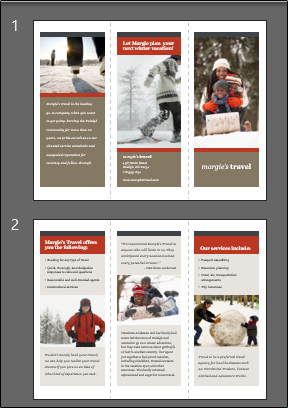
These slides contain boilerplate text and images, but the layout is exactly what you need for a tri-fold brochure. All you need to do is replace the content with your own. Let’s use the first column of slide two as an example.
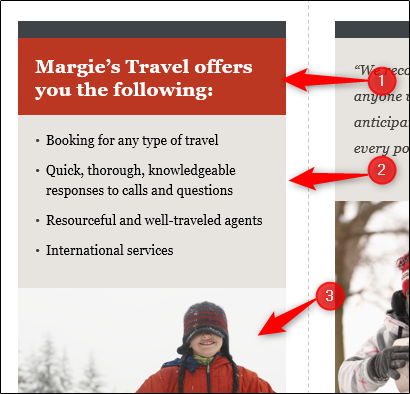
As you can see, we have three parts here—the header (1), some descriptive bullet points (2), and an image (3). Replacing the header and bullet point content with your own is easy. All you need to do is click the respective text box, delete the boilerplate content, and input your text.

To replace the image, select it and then right-click it. Click “Change Picture” from the menu that appears.

The Chrome desktop browser recently got dark mode on both Mac and Windows, but it’s also available on Android. It’s not quite as straightforward as other platforms, however, as it’s currently tucked behind a flag. Here’s how to enable it.
First things first: you’ll need to make sure Chrome is updated in the Play Store. The version should be at least 74, which you can check in Settings > About Chrome. If you don’t have 74 yet, this won’t work. It’s rolling out in stages through the Play Store, but you can also sideload the APK if you’re not into playing the waiting game.
RELATED: How to Sideload Apps on Android
Once everything is updated, fire up Chrome and type the following in the Omnibox:
chrome://flags/#enable-android-night-mode
Tap the dropdown, and set it to “Enabled.” Hit the button at the bottom to restart your browser.


Once Chrome re-opens, tap the menu button and jump back into Settings. There should be a new option called “Dark Mode” in the root menu.


If the Outlook client starts behaving oddly, one of the first things to do is see whether add-ins are causing the problem. Here’s how to disable them so you can tell if they’re the issue.
Add-ins are extra bits of functionality that software providers create to hook their application into Outlook. You can install add-ins yourself by opening Outlook and clicking Home > Get Add-ins, which will show you some of the add-ins available to you.

However, most add-ins are installed automatically when you install a piece of software on your computer. You may never use the add-ins, or even be aware that they’re there, but they aren’t (usually) malware or anything nasty. They’re intended to make it easier for you to use a product. For example, when you install Adobe’s Acrobat PDF reader, it installs an Outlook add-in that lets you make PDFs out of emails.
There’s usually no need to remove add-ins, but if Outlook starts behaving oddly—especially if it freezes, crashes, or refuses to open—then disabling the add-ins will tell you if they’re the problem.
Troubleshooting is all about finding the cause of a problem. The best way to do this is to gradually narrow down the possible issues until you’re left with just the cause of the problem. In the case of Outlook problems, this means disabling all the add-ins and, if the problem goes away, re-enabling the add-ins one by one to identify which one is causing the problem. This is particularly true if Outlook is encountering problems at startup.
The easiest way to disable all of the add-ins at once is to open Outlook in Safe Mode. This disables all the add-ins but doesn’t change anything else, so if one (or more) of the add-ins is causing the problem, everything will work as expected in Safe Mode. There are several ways to open Outlook in Safe Mode, depending on what version of Outlook and which version of Windows you’re using. There are a couple of methods that generally should work across all the combinations of supported versions of Outlook and Windows, but if these don’t work then search online for your particular combination.
This works whether you click an icon on your taskbar, desktop, or from the Windows menu. Hold down the CTRL key on your keyboard while clicking the Outlook icon (or double-clicking if your icon is on the desktop). A confirmation message will be displayed.

There’s a new Chrome attack on the horizon, and man, it’s a doozy. Dubbed the “Inception Bar” by the finder, it replicates Chrome’s Omnibox, essentially giving attackers the potential to take control of Chrome completely.
Found by developer James Fisher, the Inception Bar is an incredibly clever phishing attack that leverages the fact that Chrome for Android hides the Omnibox—that’s what the address bar on Chrome is called—as you scroll. Once you scroll down the page a bit, the Omnibox is hidden, and it’s automatically replaced with the spoofed bar. And it looks incredibly convincing—it can even lock the real Omnibox in an overflow container, preventing it from re-appearing once the Inception Bar is in place.
While it doesn’t look like this attack has been found present on the web (yet), Fisher built a working proof of concept on his site, which you can check out at the link. Once you visit the site, scroll down the page a bit, and right after the Omnibox disappears, you’ll see the spoofed Inception Bar—complete with a fake URL—appear in its place. The bar doesn’t work at this point (as it’s just a proof of concept), but it’s not hard to see how with a little bit of additional code it could become a very realistic clone. It’s also worth noting that this is still buggy—closing Chrome and reopening it will display both bars, for example.
Fisher notes in his post that he doesn’t see an easy way to fix this issue, which makes a lot of sense. Since the website itself is generating the faux bar, it will be incredibly hard for the Chome team to find a way to combat the issue.
As for possible ways for users to prevent encountering this issue should it become a legitimate problem, the first one is easy: use a different browser. Any page with the code to generate the Inception Bar will still do so, but it will be hilariously obvious because other browsers don’t use Chrome’s Omnibox. It’s also worth reiterating the fact that this only works on Chrome for Android—Chrome for iOS uses a different interface that prevents this from being any sort of convincing attack. [via Android Police]
In less terrifying news, Apple talks about why it pulled screen times apps from the App Store, Zuck built his wife a nifty “sleep box,” Facebook will be a necropolis in 50 years, Spotify hits 100m subs, and more.
Speaking of distracted driving charges, it’s time to talk about the best story from the weekend: a man spent 13 months and thousands of dollars to prove that a hashbrown is indeed not a phone.
Jason Stiber received a $300 distracted driving ticket for eating a McDonald’s hashbrown while driving. An officer mistook the breakfast food as a smartphone and gave Stiber a ticket. But he fought it in court, which revealed that the office was on the 15th hour of a 16-hour shift and his judgment may have been subpar. The case was overturned. Absolutely amazing. [The Washington Post]
